
Мы используем cookie
Настройки cookie
Обязательные cookie всегда включены, так как они нужны для корректной работы сайта.
Аналитические cookie Яндекс.Метрики и статистики платформы Tilda можно включить или отключить. Они помогают нам видеть статистику посещений и улучшать сайт.
Аналитические cookie Яндекс.Метрики и статистики платформы Tilda можно включить или отключить. Они помогают нам видеть статистику посещений и улучшать сайт.
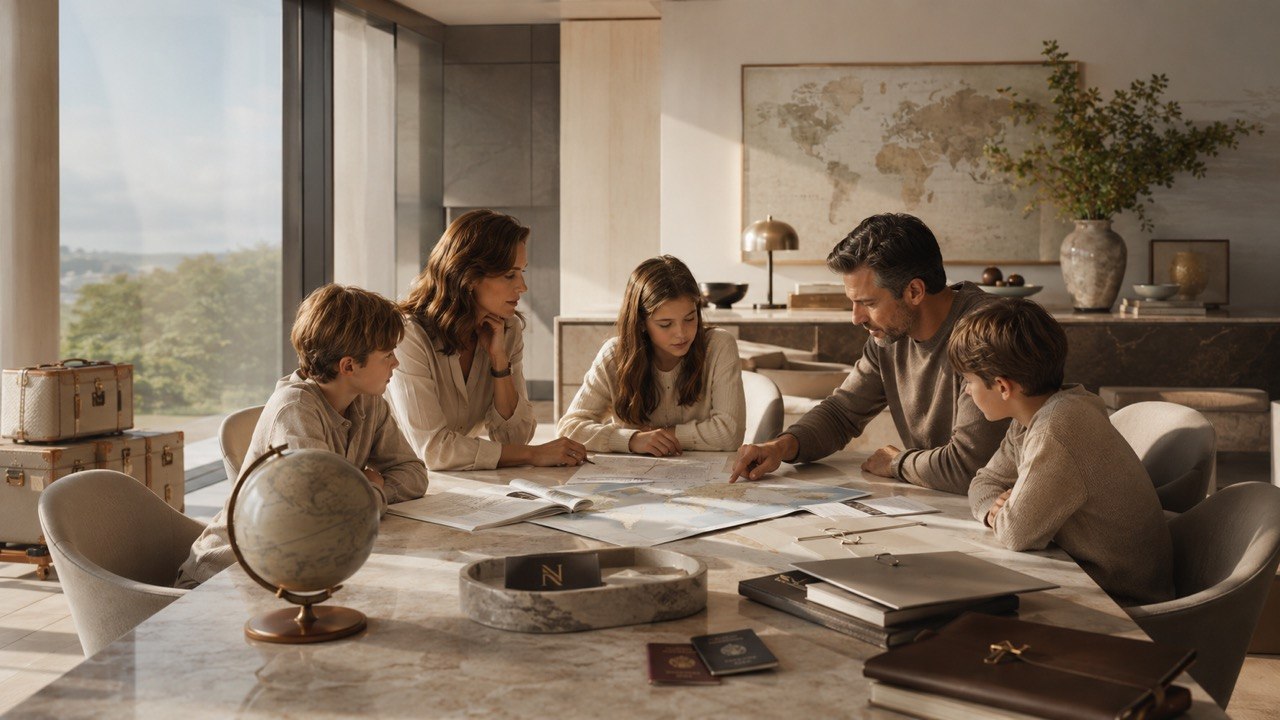
A family across several jurisdictions: capital, children, law and access
The call from the bank came on a perfectly ordinary day.
"Your son is trying to open an account in London. Do you understand how this may affect his tax status and the questions about the source of funds?"
Then came a second call, from a lawyer.
"The beneficiaries in the old structure have not been updated. If something happens, access to the assets could take months."
Then the son wrote.
"Father, I study here, I work here and I pay taxes here. Why did opening an account turn into a family problem?"
At that moment it became clear: the family does not live in countries. It lives in incompatible rules.
Every decision had its own reason. The children study in one country, the assets are in another, the business operates in a third. Accounts appeared somewhere, real estate somewhere else, a reserve elsewhere, along with tax specialists, lawyers, banks and documents. Taken one by one, almost every decision looked reasonable. Together they became a system that no one saw as a whole any more.
The new world has made a family's international life more complicated. Banks ask more questions: where the money came from, who the real owner of the assets is, who controls the structure, where the family is tax resident, which accounts and assets must be disclosed. International exchange of financial information between countries (CRS), US taxpayer account reporting rules (FATCA), requirements for a business's real presence in a jurisdiction (economic substance), the new crypto-asset reporting rules (CARF), checks on the source of funds and on beneficiaries can no longer be treated as bureaucratic noise. These are the new rules of the game.
A family used to be able to think: "We simply have assets in different countries." Now the question is different: who sees the whole map, understands the links between countries, accounts, taxes, inheritance, access and risks, and will be able to explain to the family what happens at the moment of a check, a relocation, a transfer or a crisis?
The main mistake is to assume that an international architecture is assembled from separate good decisions.
An account there. A company here. Property in a third country. Children studying in a fourth. A reserve in a fifth. A lawyer in one jurisdiction, a tax adviser in another, a bank in a third, family documents in a fourth.
Each piece may be reasonable on its own. Together they can turn out to be a labyrinth.
A family in several jurisdictions needs not a collection of answers but a map of the whole.
Who lives where. Who is a tax resident where. Where the assets are. Where the business is. Where the accounts are. Where the documents are. Where the children are now and where they may be tomorrow. Who has access. Who has signing authority. Which decisions require a local legal, tax or compliance check. What happens in the event of illness, death, divorce, relocation, a child reaching adulthood, the sale of a business, an account being blocked, a change of rules or a change in a bank's policy.
These are not questions for general advice from the internet. They need to be checked with qualified specialists in the specific jurisdictions.
Family Capital Architecture does not replace a lawyer, a tax adviser or a compliance expert. It does something else: it links their answers into a single family picture. Because a family does not live in fragments.
If the tax answer is not linked to inheritance, a gap may appear. If the legal structure is not linked to access, it may fail in a crisis. If the children study abroad but the family does not think about their future residency, it may become a deferred question. If the second partner does not understand the international infrastructure, it exists only in the head of one person.
Many countries do not mean much resilience. Sometimes they simply mean more points of failure.
Many countries do not mean much resilience. Sometimes they simply mean more points of failure.
The physical resilience of a place to live also becomes part of the family decision. Energy, medicine, infrastructure, water, transport, cost of living, property insurance and access to quality services are no longer distant macroeconomics. They answer the question: where can the family actually live, recover, educate its children, support its elders and hold a reserve.
But the core remains the same: who sees the whole map?
A strong international architecture must be explainable to the family in human language. What is where. Why it is arranged that way. Who knows what. What must not be done without a check. Where there is a risk of blocking, delay, a bank refusal, a tax question or legal incompatibility.
The main question is not "where is it better to open an account" and not "which country is more reliable." The main question is: who is able to assemble the whole family system into a single map of decisions?
Internationality becomes not an architecture of freedom but a set of doors whose keys are held in different hands.
The final question: if tomorrow your family has to act in several jurisdictions at once, who will be able to assemble the whole picture faster than the consequences begin?
We use cookies
Cookie settings
Essential cookies are always enabled because they are required for the website to work correctly.
Analytical cookies from Yandex Metrica can be enabled or disabled.
Analytical cookies from Yandex Metrica can be enabled or disabled.
