
Мы используем cookie
Настройки cookie
Обязательные cookie всегда включены, так как они нужны для корректной работы сайта.
Аналитические cookie Яндекс.Метрики и статистики платформы Tilda можно включить или отключить. Они помогают нам видеть статистику посещений и улучшать сайт.
Аналитические cookie Яндекс.Метрики и статистики платформы Tilda можно включить или отключить. Они помогают нам видеть статистику посещений и улучшать сайт.
We use cookies
Cookie settings
Essential cookies are always enabled because they are required for the website to work correctly.
Analytical cookies from Yandex Metrica can be enabled or disabled.
Analytical cookies from Yandex Metrica can be enabled or disabled.
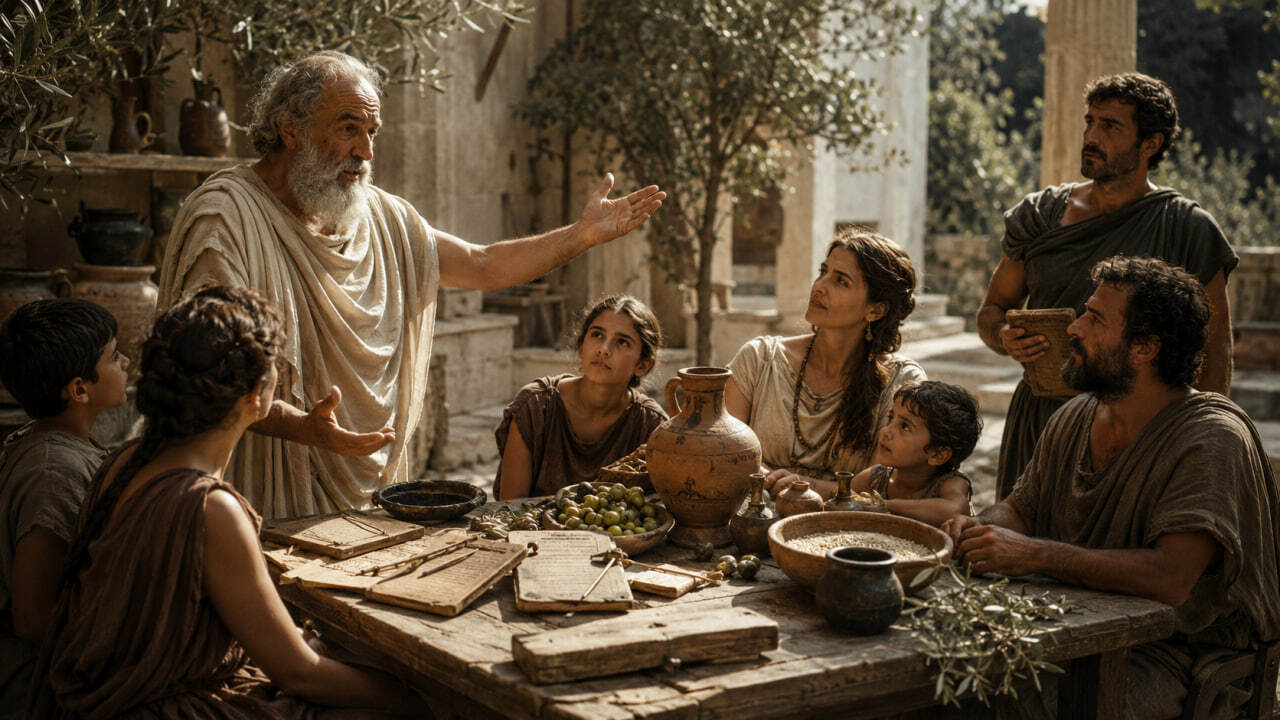
How Humanity Learned to See Family Wealth as a Whole
A wealthy family may work simultaneously with a skilled investment manager, a good lawyer, a tax specialist, an insurance adviser, a private banker and a family office. Each may be right within their own remit. Yet between professionally sound decisions, a question sometimes remains that none of them is required to answer in full:
Who is responsible for the coherence of family capital when every capable specialist is responsible only for their own part?
The history of this question is not a ladder of professions. Insurance did not give rise to financial planning. Financial planning did not give rise to the family office. Family governance, wealth management, behavioural science and scenario thinking developed along their own paths.
The professions did not advance in formation. Their separate streams converged.
This article brings together the professional and intellectual traditions directly relevant to the lineage of MN SAPIENS.
Who is responsible for the coherence of family capital when every capable specialist is responsible only for their own part?
The history of this question is not a ladder of professions. Insurance did not give rise to financial planning. Financial planning did not give rise to the family office. Family governance, wealth management, behavioural science and scenario thinking developed along their own paths.
The professions did not advance in formation. Their separate streams converged.
This article brings together the professional and intellectual traditions directly relevant to the lineage of MN SAPIENS.
First, People Had to Learn to Survive Loss

The written history of insurance reasoning reaches back at least to eighteenth-century BCE Babylon. Maritime lending already contained a simple but powerful idea: part of the risk of a voyage could be transferred from the merchant to the financing party. This was not yet a modern insurance policy. But the economic problem is recognisable: how can one major loss be prevented from destroying everything that has been built?

Thousands of years later, this question became a profession, a market and an infrastructure. In the 1680s, Edward Lloyd’s coffee house by the Thames became a meeting place for maritime information. Ships, cargo, routes, weather and the cost of error ceased to be abstractions. This environment gave rise to one of the most important centres of the modern insurance market.
As insurance developed, agents, brokers and insurance advisers emerged between the system of risk and the individual. Their precise roles and legal status vary by country, but their human task is understandable without a legal dictionary. Someone must sit across from an owner and ask an uncomfortable question: what happens to the home, business or family income if the familiar order collapses tomorrow?
That conversation matters in its own right. An insurance specialist can identify a vulnerability and select a protective mechanism. Yet even impeccable coverage of a particular risk does not determine the family’s overall direction, the distribution of roles or the preparation of the next person to assume responsibility.
Working with risk taught humanity to protect what it had built.
As insurance developed, agents, brokers and insurance advisers emerged between the system of risk and the individual. Their precise roles and legal status vary by country, but their human task is understandable without a legal dictionary. Someone must sit across from an owner and ask an uncomfortable question: what happens to the home, business or family income if the familiar order collapses tomorrow?
That conversation matters in its own right. An insurance specialist can identify a vulnerability and select a protective mechanism. Yet even impeccable coverage of a particular risk does not determine the family’s overall direction, the distribution of roles or the preparation of the next person to assume responsibility.
Working with risk taught humanity to protect what it had built.
When It Began to Matter Whose Side the Adviser Was On

Theodore Roosevelt’s trusted financial confidant was his cousin William Emlen Roosevelt, a New York banker. Their surviving correspondence concerns concrete financial matters: Emlen reported inheritance payments, asked Theodore for instructions on how to use the funds and, in 1907, wrote that inherited money had already been invested.
The need for trusted financial judgement predates the modern financial adviser profession. The modern model of independent financial advice developed later; the Roosevelt story concerns trusted financial relationships of its own time.
In 1912, Theodore Dreiser published The Financier. In creating Frank Cowperwood, he drew, among other sources, on the life of financier Charles Yerkes. The novel shows how familiar the figure of the financier had become in American culture. A financier, a trusted adviser and a modern independent financial adviser remain distinct roles.
After the First World War, investment counsel began to emerge as a separate profession in the United States. In its early professional ideal, personal advice was to begin with the investor’s circumstances, while judgement was to be separated from the interest in selling a security.
Trust in a person alone was no longer sufficient. It became necessary to specify what shaped the adviser’s professional judgement and whose interests it represented.
Financial planning introduced a further question: how can financial decisions be connected to life goals and time?
The need for trusted financial judgement predates the modern financial adviser profession. The modern model of independent financial advice developed later; the Roosevelt story concerns trusted financial relationships of its own time.
In 1912, Theodore Dreiser published The Financier. In creating Frank Cowperwood, he drew, among other sources, on the life of financier Charles Yerkes. The novel shows how familiar the figure of the financier had become in American culture. A financier, a trusted adviser and a modern independent financial adviser remain distinct roles.
After the First World War, investment counsel began to emerge as a separate profession in the United States. In its early professional ideal, personal advice was to begin with the investor’s circumstances, while judgement was to be separated from the interest in selling a security.
Trust in a person alone was no longer sufficient. It became necessary to specify what shaped the adviser’s professional judgement and whose interests it represented.
Financial planning introduced a further question: how can financial decisions be connected to life goals and time?
When Financial Life No Longer Fitted Inside a Product

On 12 December 1969, thirteen people gathered in a hotel meeting room near Chicago’s O’Hare Airport. Loren Dunton and James R. Johnston organised the meeting. Eleven invitees travelled from Florida, New York, Ohio and Pennsylvania at their own expense. They included sellers of insurance, mutual funds and securities, a financial consultant and a writer. They came from a professional world in which financial services were divided by product and speciality.
They wanted to raise professional standards in retail financial services and place financial counselling, rather than sales alone, at the centre. CFP Board describes this meeting as an important milestone towards a profession combining knowledge and practice from fragmented areas of financial services. A professional association and the College for Financial Planning grew out of the meeting. The work did not end that evening: on 13 December, the participants met again to continue establishing the new organisations.
1969 matters because fragmentation itself became an explicit professional problem.
A person rarely needs just one good instrument. Reserves affect investments. A house changes debt exposure. Children’s education competes for the same cash flow as their parents’ future freedom. Insurance protection, taxes, savings and investments cease to be separate purchases when they must fit together over time.
The plan gave money a timeline.
Time revealed the next difficulty. People formulate goals. Two family members may both say “security” while meaning different amounts, risks and degrees of freedom. They may agree on an education budget without agreeing on what counts as a good education. An acceptable level of risk may be calculated, only to reveal later that one owner never accepted that risk.
Financial planning connected financial decisions with life goals.
The independence of advice continued to develop along a separate line. In Britain in 1987–1988, the issue acquired a clear regulatory form: polarisation rules separated provider representatives from independent intermediaries. An independent intermediary was expected to act on the client’s side and consider a market broader than a single company’s product range. The meaning of independence varies across countries and periods, but the professional question had become clear: whose interests does the adviser represent?
Investment management added another discipline: what should be done with the assets themselves when the cost of error is measured in money every day?
They wanted to raise professional standards in retail financial services and place financial counselling, rather than sales alone, at the centre. CFP Board describes this meeting as an important milestone towards a profession combining knowledge and practice from fragmented areas of financial services. A professional association and the College for Financial Planning grew out of the meeting. The work did not end that evening: on 13 December, the participants met again to continue establishing the new organisations.
1969 matters because fragmentation itself became an explicit professional problem.
A person rarely needs just one good instrument. Reserves affect investments. A house changes debt exposure. Children’s education competes for the same cash flow as their parents’ future freedom. Insurance protection, taxes, savings and investments cease to be separate purchases when they must fit together over time.
The plan gave money a timeline.
Time revealed the next difficulty. People formulate goals. Two family members may both say “security” while meaning different amounts, risks and degrees of freedom. They may agree on an education budget without agreeing on what counts as a good education. An acceptable level of risk may be calculated, only to reveal later that one owner never accepted that risk.
Financial planning connected financial decisions with life goals.
The independence of advice continued to develop along a separate line. In Britain in 1987–1988, the issue acquired a clear regulatory form: polarisation rules separated provider representatives from independent intermediaries. An independent intermediary was expected to act on the client’s side and consider a market broader than a single company’s product range. The meaning of independence varies across countries and periods, but the professional question had become clear: whose interests does the adviser represent?
Investment management added another discipline: what should be done with the assets themselves when the cost of error is measured in money every day?
A Portfolio Requires Its Own Precision
Investment management created a language of risk, return, liquidity, time horizon, constraints and authority. Competence here cannot be replaced by a discussion of wholeness.
A portfolio manager has specific responsibilities: to understand acceptable risk, which assets are needed, when liquidity is required and the limits within which decisions may be made.
But a portfolio does not know who will access the necessary account if the key person becomes unavailable. It cannot explain why two owners respond differently to the same market decline. It cannot decide which part of capital the family regards as a reserve of freedom, which as a resource for the next generation and which as the basis for entrepreneurial risk.
The strength of the investment profession is reflected, among other things, in the clarity of its boundaries.
A portfolio manager has specific responsibilities: to understand acceptable risk, which assets are needed, when liquidity is required and the limits within which decisions may be made.
But a portfolio does not know who will access the necessary account if the key person becomes unavailable. It cannot explain why two owners respond differently to the same market decline. It cannot decide which part of capital the family regards as a reserve of freedom, which as a resource for the next generation and which as the basis for entrepreneurial risk.
The strength of the investment profession is reflected, among other things, in the clarity of its boundaries.
When a Single Portfolio Was No Longer Enough
A wealthy person’s assets rarely end with an investment account. Business, property, borrowing, complex assets, liquidity, insurance, inheritance, several countries and family obligations begin to affect one another.
A broader practice of Wealth Management gradually developed around wealthy individuals. Its task no longer fitted within a single investment portfolio. Liquidity, business, property, protection, inheritance and multiple countries had to be connected. The precise scope depends on the firm, jurisdiction and service model.
As this practice broadened, the distinction became more apparent between the financial system surrounding an individual and the family itself, where several people have different roles, rights, knowledge and expectations of the future.
The family office took the response to this problem particularly far.
A broader practice of Wealth Management gradually developed around wealthy individuals. Its task no longer fitted within a single investment portfolio. Liquidity, business, property, protection, inheritance and multiple countries had to be connected. The precise scope depends on the firm, jurisdiction and service model.
As this practice broadened, the distinction became more apparent between the financial system surrounding an individual and the family itself, where several people have different roles, rights, knowledge and expectations of the future.
The family office took the response to this problem particularly far.
The Family Office: History Disrupts the Neat Ladder
In 1882, John D. Rockefeller established his own family infrastructure. The University of Chicago Booth School of Business writes that it is widely regarded as the first full-service single-family office in the United States. His trusted adviser Frederick T. Gates worked alongside Rockefeller, while a professional administrative system gradually formed around the family.
The date deserves attention. 1882 precedes the 1969 Chicago milestone in financial planning.
There was therefore no neat historical ladder of “financial planning, then wealth management, then the family office”. Different responses to the complexity of wealthy families arose in different places and for different reasons.
The family office became a major external reference point for coordination around one family. It can connect investments, reporting, law, taxation, risk management, family governance, succession, philanthropy, preparation of the next generation and everyday infrastructure.
Family Capital Architecture raises the question of coherence alongside this, including where there is no family office and specialists operate separately.
The next turn in this history concerns the definition of family wealth itself.
The date deserves attention. 1882 precedes the 1969 Chicago milestone in financial planning.
There was therefore no neat historical ladder of “financial planning, then wealth management, then the family office”. Different responses to the complexity of wealthy families arose in different places and for different reasons.
The family office became a major external reference point for coordination around one family. It can connect investments, reporting, law, taxation, risk management, family governance, succession, philanthropy, preparation of the next generation and everyday infrastructure.
Family Capital Architecture raises the question of coherence alongside this, including where there is no family office and specialists operate separately.
The next turn in this history concerns the definition of family wealth itself.
Wealth Turned Out to Be Broader Than Money
In the tradition of James E. Hughes Jr., family wealth extends beyond financial assets. The first edition of Family Wealth: Keeping It in the Family, privately published in 1997, explicitly described family wealth through three forms of capital: human, intellectual and financial.
Twenty years later, Complete Family Wealth, first published by Wiley in 2017 and written by James E. Hughes Jr., Susan E. Massenzio and Keith Whitaker, explicitly defined five capitals: human, intellectual, social, spiritual and financial.
These two books reveal a change in vocabulary from three named capitals to five. They document the transition itself; its precise timing and motivation lie beyond the verified material.
The five-capital framework belongs to the intellectual tradition of James E. Hughes Jr.; MN SAPIENS uses it with explicit attribution.
Each term has a concrete human meaning. Human capital resides in people: their condition, identity and capacity to live, work and act. Intellectual capital comprises knowledge, experience, learning and the ability to pass knowledge on. Social capital lives in relationships within the family and with the wider world, and in the capacity to decide and act together. Spiritual capital concerns a shared intention that may extend beyond one person’s interests. Financial capital includes the family’s property and financial resources and can support the development of the other capitals.
In Hughes’s tradition, these form an interconnected system without a moral hierarchy among the capitals. Financial capital can support health, education, time, relationships and shared endeavour.
This distinction changes the subject of the conversation. If wealth equals property, the central question can readily be reduced to preserving and transferring assets. If wealth includes people, their knowledge, relationships, shared intention and financial resources, inheritance becomes more than a transfer of ownership.
A family may possess substantial assets yet depend on one person who knows every account, access credential and decision rationale. It may pay for the best education without preparing the future owner for ownership. It may produce excellent legal documents without agreeing why shared capital should outlive the current generation.
Twenty years later, Complete Family Wealth, first published by Wiley in 2017 and written by James E. Hughes Jr., Susan E. Massenzio and Keith Whitaker, explicitly defined five capitals: human, intellectual, social, spiritual and financial.
These two books reveal a change in vocabulary from three named capitals to five. They document the transition itself; its precise timing and motivation lie beyond the verified material.
The five-capital framework belongs to the intellectual tradition of James E. Hughes Jr.; MN SAPIENS uses it with explicit attribution.
Each term has a concrete human meaning. Human capital resides in people: their condition, identity and capacity to live, work and act. Intellectual capital comprises knowledge, experience, learning and the ability to pass knowledge on. Social capital lives in relationships within the family and with the wider world, and in the capacity to decide and act together. Spiritual capital concerns a shared intention that may extend beyond one person’s interests. Financial capital includes the family’s property and financial resources and can support the development of the other capitals.
In Hughes’s tradition, these form an interconnected system without a moral hierarchy among the capitals. Financial capital can support health, education, time, relationships and shared endeavour.
This distinction changes the subject of the conversation. If wealth equals property, the central question can readily be reduced to preserving and transferring assets. If wealth includes people, their knowledge, relationships, shared intention and financial resources, inheritance becomes more than a transfer of ownership.
A family may possess substantial assets yet depend on one person who knows every account, access credential and decision rationale. It may pay for the best education without preparing the future owner for ownership. It may produce excellent legal documents without agreeing why shared capital should outlive the current generation.
Who Speaks for the Family?
Once people, as well as assets, enter the picture, roles must be distinguished.
The traditions of family enterprise and family governance have long shown that family, ownership and business overlap without being identical. Renato Tagiuri and John Davis gave this distinction a simple map of three intersecting systems: family, ownership and business.
At the family table, someone may be a son or daughter. As an owner, they may be a shareholder. In the business, the same person may be an executive. The person remains the same; the role, authority, responsibility and criteria for a good decision change.
These roles are easily confused within a family. People sit together as relatives while arguing simultaneously as parents, owners and managers. A dispute may appear financial while actually concerning authority, fairness, responsibility or the future of the business.
Family governance makes rights, roles and ways of making joint decisions visible. But a document does not speak for a person. Legal authority does not automatically create competence. A formal rule does not guarantee that two participants understand events in the same way.
The traditions of family enterprise and family governance have long shown that family, ownership and business overlap without being identical. Renato Tagiuri and John Davis gave this distinction a simple map of three intersecting systems: family, ownership and business.
At the family table, someone may be a son or daughter. As an owner, they may be a shareholder. In the business, the same person may be an executive. The person remains the same; the role, authority, responsibility and criteria for a good decision change.
These roles are easily confused within a family. People sit together as relatives while arguing simultaneously as parents, owners and managers. A dispute may appear financial while actually concerning authority, fairness, responsibility or the future of the business.
Family governance makes rights, roles and ways of making joint decisions visible. But a document does not speak for a person. Legal authority does not automatically create competence. A formal rule does not guarantee that two participants understand events in the same way.
One Family, Several Maps
A technical system favours a single source of data. A family works differently.
One person believes the financial picture is transparent. Another does not know where the key documents are. One believes a conversation about the future has already taken place. Another remembers only isolated remarks.
When several people describe the same situation, differences between their answers should not always be smoothed into an average. Sometimes the difference itself is the important information.
Clinical and psychological methods require separate evaluation before being applied to work with wealthy families. The practical conclusion here is simpler: preserve the family’s separate voices rather than create a third, “average” voice.
A complete picture begins by preserving differences.
Even a good map of the present will quickly become outdated if the family treats the future as a single scenario.
One person believes the financial picture is transparent. Another does not know where the key documents are. One believes a conversation about the future has already taken place. Another remembers only isolated remarks.
When several people describe the same situation, differences between their answers should not always be smoothed into an average. Sometimes the difference itself is the important information.
Clinical and psychological methods require separate evaluation before being applied to work with wealthy families. The practical conclusion here is simpler: preserve the family’s separate voices rather than create a third, “average” voice.
A complete picture begins by preserving differences.
Even a good map of the present will quickly become outdated if the family treats the future as a single scenario.
A Family Always Has More Than One Future
In twenty years, people, roles and sources of income will change. Someone will leave the business. Someone will become an owner for the first time. New countries, technologies, constraints and family relationships will emerge. Health and energy will change too.
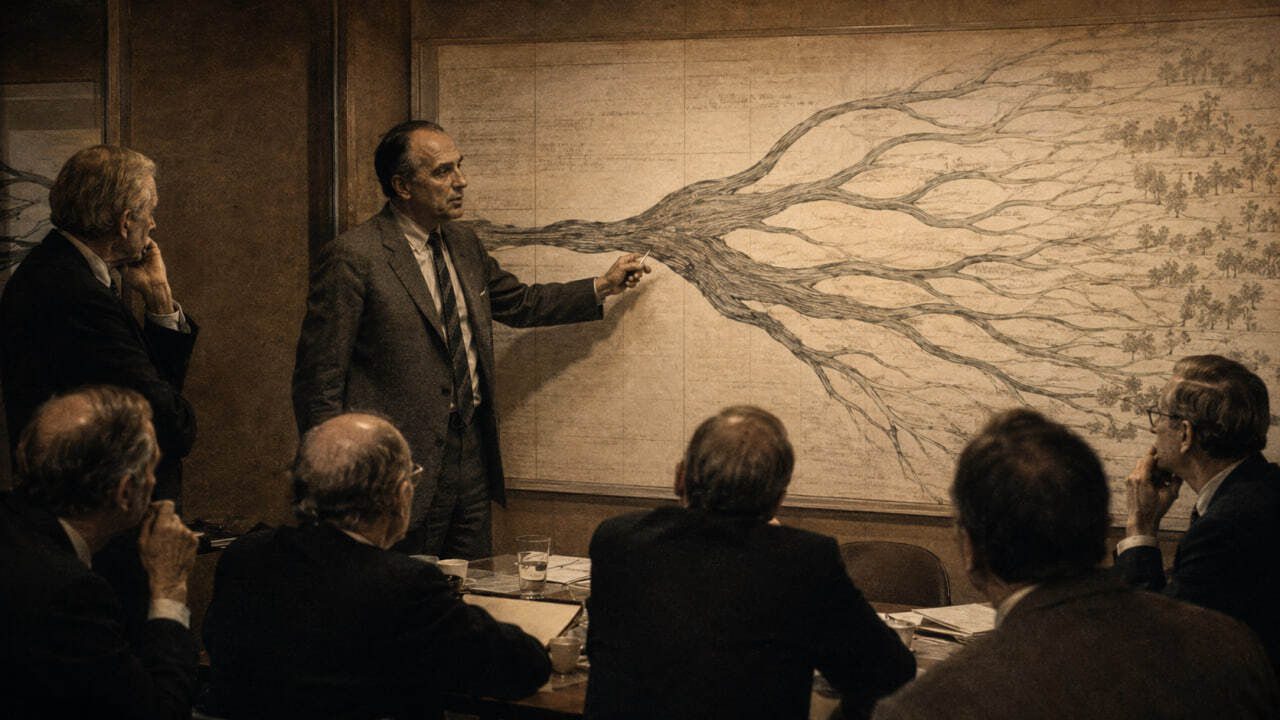
In September 1972, Shell’s head of scenario work, Pierre Wack, presented six scenarios in a three-hour presentation as a river: first dividing into two channels, each then branching into three tributaries. This image captures the idea of scenario thinking: several possible futures can unfold from a single present. Wack’s and Shell’s work became a notable strand of scenario practice; for MN SAPIENS, it is an external source for working with uncertainty.
Its practical value can be expressed in one question:
If reality departs from the baseline scenario, will the family retain its ability to make decisions?
Today’s assets, actual people and several possible futures then enter the same picture.
A space becomes visible that even capable specialists do not automatically cover.
Its practical value can be expressed in one question:
If reality departs from the baseline scenario, will the family retain its ability to make decisions?
Today’s assets, actual people and several possible futures then enter the same picture.
A space becomes visible that even capable specialists do not automatically cover.
Where the Whole Is Lost
A lawyer may build a valid structure that does not reflect the family’s agreed strategic direction. A manager may construct a rational portfolio that one owner is not prepared to withstand. A family office may have excellent infrastructure while critical decision logic remains in one person’s head.
Each specialist may be doing their own work professionally. The problem arises in the connections between decisions.
Who checks whether the legal structure matches the family’s understanding of its future? Who notices that a financial goal is formally shared but means different things to two participants? Who frames the question for a specialist so that they solve the family’s problem rather than only its technical fragment?
Coherence begins when the connections between strong decisions cease to be nobody’s responsibility.
Each specialist may be doing their own work professionally. The problem arises in the connections between decisions.
Who checks whether the legal structure matches the family’s understanding of its future? Who notices that a financial goal is formally shared but means different things to two participants? Who frames the question for a specialist so that they solve the family’s problem rather than only its technical fragment?
Coherence begins when the connections between strong decisions cease to be nobody’s responsibility.
Why This Question Became Mine

I came to it from within financial practice.
My professional background includes an FFMS 1.0 qualification certificate and a financial adviser diploma from the Financial University under the Government of the Russian Federation. Behind those credentials lay practical work in independent financial advice, financial planning, investment and Wealth Management.
This work taught me to calculate, compare risks, work with capital and understand the cost of financial decisions. It also revealed a clear boundary: a financial task and a family’s system of decisions require work at different scales.
On 31 December 2022, I paused before the familiar task of setting goals for the following year. Income was growing, but I had no clear answer about where I wanted my life to go over five, ten or twenty years. The question was shorter than any financial model: “Where is my life heading?”
At first I sought an answer for myself. Then the longer horizon entered my work with families and capital. The financial plan ceased to be the endpoint and became one layer of a broader task.
For me, an Architect of Family Capital maintains the architecture of the family’s task and the connections between direction, roles, capital and the work of specialists. This work has its own professional financial foundation. Legal, tax, insurance, investment, medical and other specialist decisions remain within the competence and responsibility of the relevant professionals. The Architect’s task is to frame a precise question for them and maintain the connections between decisions.
My professional background includes an FFMS 1.0 qualification certificate and a financial adviser diploma from the Financial University under the Government of the Russian Federation. Behind those credentials lay practical work in independent financial advice, financial planning, investment and Wealth Management.
This work taught me to calculate, compare risks, work with capital and understand the cost of financial decisions. It also revealed a clear boundary: a financial task and a family’s system of decisions require work at different scales.
On 31 December 2022, I paused before the familiar task of setting goals for the following year. Income was growing, but I had no clear answer about where I wanted my life to go over five, ten or twenty years. The question was shorter than any financial model: “Where is my life heading?”
At first I sought an answer for myself. Then the longer horizon entered my work with families and capital. The financial plan ceased to be the endpoint and became one layer of a broader task.
For me, an Architect of Family Capital maintains the architecture of the family’s task and the connections between direction, roles, capital and the work of specialists. This work has its own professional financial foundation. Legal, tax, insurance, investment, medical and other specialist decisions remain within the competence and responsibility of the relevant professionals. The Architect’s task is to frame a precise question for them and maintain the connections between decisions.
The MN SAPIENS Response: Maintain the Connections
MN SAPIENS brings together the strengths of existing professions and approaches around one task: maintaining coherence between the family, decisions and capitals over a long horizon.
One of its own tools for this work is the Family Capital Cascade:
Meaning -> Energy -> Thinking -> Trust -> Money.
The Cascade does not assign a cause. It sets the order of inquiry.
A financial shock may occur first, and money can support human, intellectual, social and spiritual capital.
MN SAPIENS explicitly draws on existing traditions of the five capitals, family governance, scenario thinking and family offices. Its own contribution begins with the way these layers are connected into a reproducible architecture while respecting specialist boundaries.
A 20–100-year horizon is a discipline of inquiry: do today’s decisions retain their meaning as people, roles, assets and external conditions change?
One of its own tools for this work is the Family Capital Cascade:
Meaning -> Energy -> Thinking -> Trust -> Money.
The Cascade does not assign a cause. It sets the order of inquiry.
A financial shock may occur first, and money can support human, intellectual, social and spiritual capital.
MN SAPIENS explicitly draws on existing traditions of the five capitals, family governance, scenario thinking and family offices. Its own contribution begins with the way these layers are connected into a reproducible architecture while respecting specialist boundaries.
A 20–100-year horizon is a discipline of inquiry: do today’s decisions retain their meaning as people, roles, assets and external conditions change?
A Discipline Is Tested Through Its Work
Today, Family Capital Architecture is a discipline developed by MN SAPIENS. It does not yet have the status of an externally recognised independent profession.
Its professional status will depend on whether the practice withstands professional criticism, accumulates results, respects the boundaries of adjacent professions and works without the author’s constant presence.
Family offices, the family wealth tradition and family governance already sustain different forms of coherence. The standard for MN SAPIENS is therefore higher: to demonstrate a distinct, testable and reproducible way of connecting family, decisions and capitals over a long horizon.
A family may have excellent specialists for every aspect of its capital. Coherence does not require replacing them with one universal adviser.
It requires ensuring that the family itself is not lost between capable specialists.
Its professional status will depend on whether the practice withstands professional criticism, accumulates results, respects the boundaries of adjacent professions and works without the author’s constant presence.
Family offices, the family wealth tradition and family governance already sustain different forms of coherence. The standard for MN SAPIENS is therefore higher: to demonstrate a distinct, testable and reproducible way of connecting family, decisions and capitals over a long horizon.
A family may have excellent specialists for every aspect of its capital. Coherence does not require replacing them with one universal adviser.
It requires ensuring that the family itself is not lost between capable specialists.
