
Мы используем cookie
Настройки cookie
Обязательные cookie всегда включены, так как они нужны для корректной работы сайта.
Аналитические cookie Яндекс.Метрики и статистики платформы Tilda можно включить или отключить. Они помогают нам видеть статистику посещений и улучшать сайт.
Аналитические cookie Яндекс.Метрики и статистики платформы Tilda можно включить или отключить. Они помогают нам видеть статистику посещений и улучшать сайт.
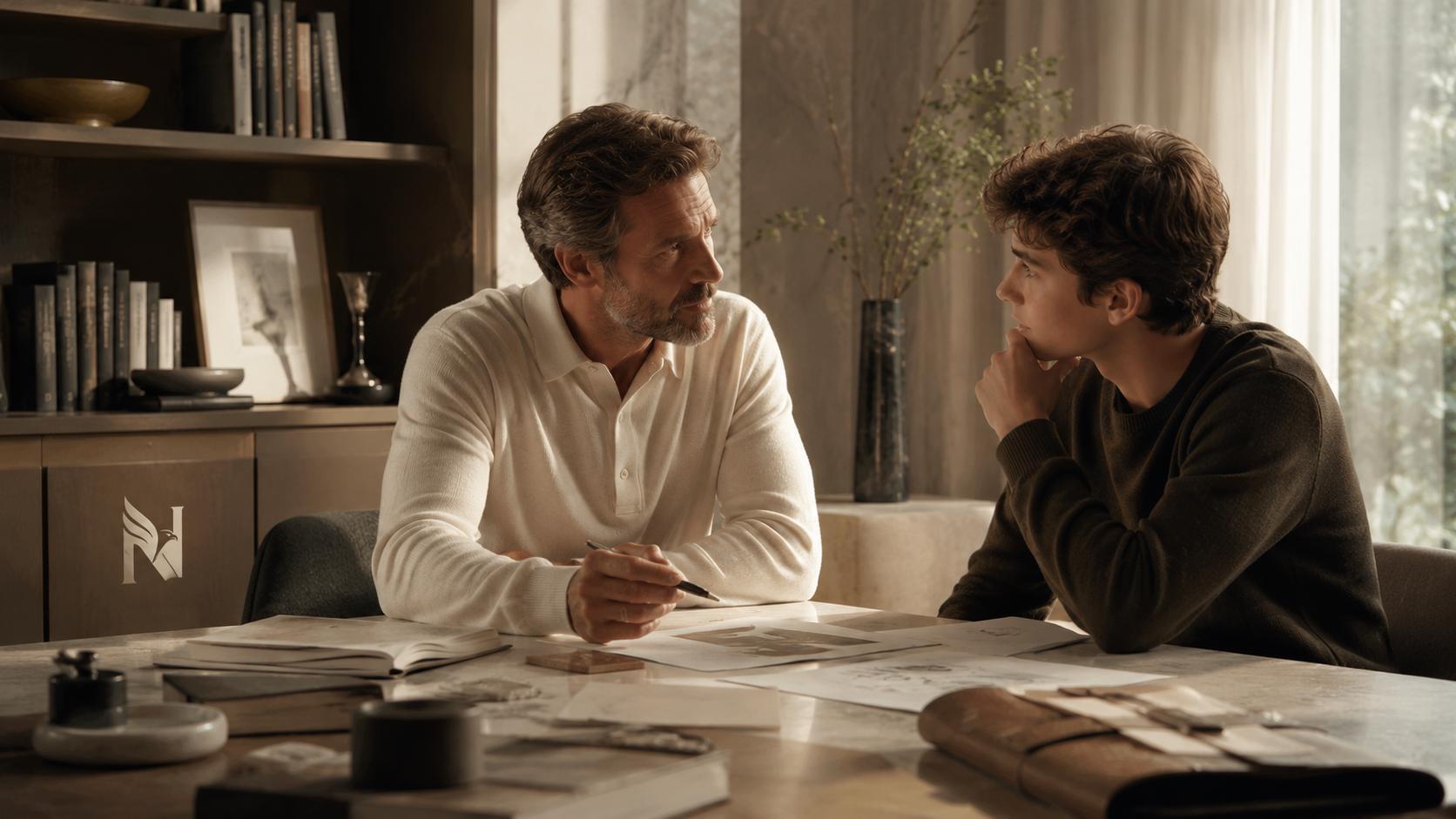
Pass On Judgement to an Heir, Not Just an Account
Gathering scene.
The young person is given access to meaningful money. Not to everything at once, carefully, “under supervision.” Adults say the right words: responsibility, trust, independence.
He nods. He doesn't look frivolous. He is educated, well-mannered, has seen a lot, and speaks well.
Then the first real decision comes. Not educational. Not about pocket money. About risk, desire, the influence of friends, a beautiful opportunity, the fear of missing out, the desire to prove that he is already an adult.
And suddenly it becomes clear: the bill was handed over before the judgment.
Access to money and the ability to make decisions are two different things.
Families often prepare the transfer of assets technically: documents, structure, shares, accounts, tax issues, legal security. This is necessary. But technical transfer does not answer the most human question: what will the heir do when there is no adult nearby who will stop, explain or take responsibility?
Judgment is not just the mind.
A smart person may make immature financial decisions. An educated person can succumb to status. A kind person may not be able to refuse. The brave may confuse risk with self-affirmation. A cautious person may defend himself all his life and not decide to take the right step.
Judgment is the ability to see consequences, costs, context, people, one's motivation, and the limits of a decision. It does not appear when accessing the account. It grows through experience.
The heir needs to learn to distinguish a desire from a goal, an opportunity from a trap, a risk from excitement, generosity from rescue, independence from a demonstration of adulthood. This cannot be conveyed in one lecture. And it is impossible to buy a mentor if the family itself does not create an environment where decisions can be discussed honestly.
Judgment is formed through small real decisions.
Not toy ones, where a mistake costs nothing. And not catastrophic ones, where the price breaks a person. We need solutions with a reasonable price: choose, calculate, explain, make a mistake, correct, draw a conclusion. We need an experience where a child or young adult not only receives a resource, but understands the consequences of a choice.
Not toy ones, where a mistake costs nothing. And not catastrophic ones, where the price breaks a person. We need solutions with a reasonable price: choose, calculate, explain, make a mistake, correct, draw a conclusion. We need an experience where a child or young adult not only receives a resource, but understands the consequences of a choice.
Wealthy families are often afraid of their children's mistakes. This is understandable. The cost of a mistake may be higher, the circle of people is wider, and the reputational risk is greater.
But if all mistakes are eliminated, the child will not become mature. He will become the man who makes his first real mistake too late.
The late first mistake is often the most costly.
Therefore, the task of the family is not to remove all mistakes, but to design a ladder of experience. Small decisions. Small budgets. Real responsibility. Gradual expansion. Conversation after selection. Not humiliation for a mistake, but an analysis: what did you see, what didn’t you see, where was the emotion, who influenced it, what will you do differently?
Judgment does not grow from shame. It grows from honest feedback.
Another layer is also important: the heir must know the family capital rules. Not just “what we have”, but “why we have it”. What decisions are not suitable for the family? What income is unacceptable according to values. How the family feels about duty, risk, helping others, publicity, status, obligations. Where is the border between personal freedom and responsibility to the family?
Without these rules, the heir is left alone with money, the market, friends, advisors, fashion and his own desire to be significant. Then the score becomes louder than the inner voice.
Without these rules, the heir is left alone with money, the market, friends, advisors, fashion and his own desire to be significant. Then the score becomes louder than the inner voice.
The track of child development and family maturation in MN SAPIENS is needed specifically for the development of judgment. Not to make a mini-investor out of a child. Not so that he would speak the language of adults early. And so that he gradually learns to be a person who can be trusted not only with access, but also with choice.
These are different levels of trust.
Access can be given. Judgment needs to be cultivated.
These are different levels of trust.
Access can be given. Judgment needs to be cultivated.
The question for the family is not when the heir will receive the money. The question is what decisions he already knows how to make without external support.
If there are few such decisions, the bill would be better off waiting.
Final question: What experience of choice, error and responsibility should your heir have before gaining access to what can no longer be called training?
If there are few such decisions, the bill would be better off waiting.
Final question: What experience of choice, error and responsibility should your heir have before gaining access to what can no longer be called training?
We use cookies
Cookie settings
Essential cookies are always enabled because they are required for the website to work correctly.
Analytical cookies from Yandex Metrica can be enabled or disabled.
Analytical cookies from Yandex Metrica can be enabled or disabled.
