
Мы используем cookie
Настройки cookie
Обязательные cookie всегда включены, так как они нужны для корректной работы сайта.
Аналитические cookie Яндекс.Метрики и статистики платформы Tilda можно включить или отключить. Они помогают нам видеть статистику посещений и улучшать сайт.
Аналитические cookie Яндекс.Метрики и статистики платформы Tilda можно включить или отключить. Они помогают нам видеть статистику посещений и улучшать сайт.
Heir and successor: why capital cannot simply be transferred
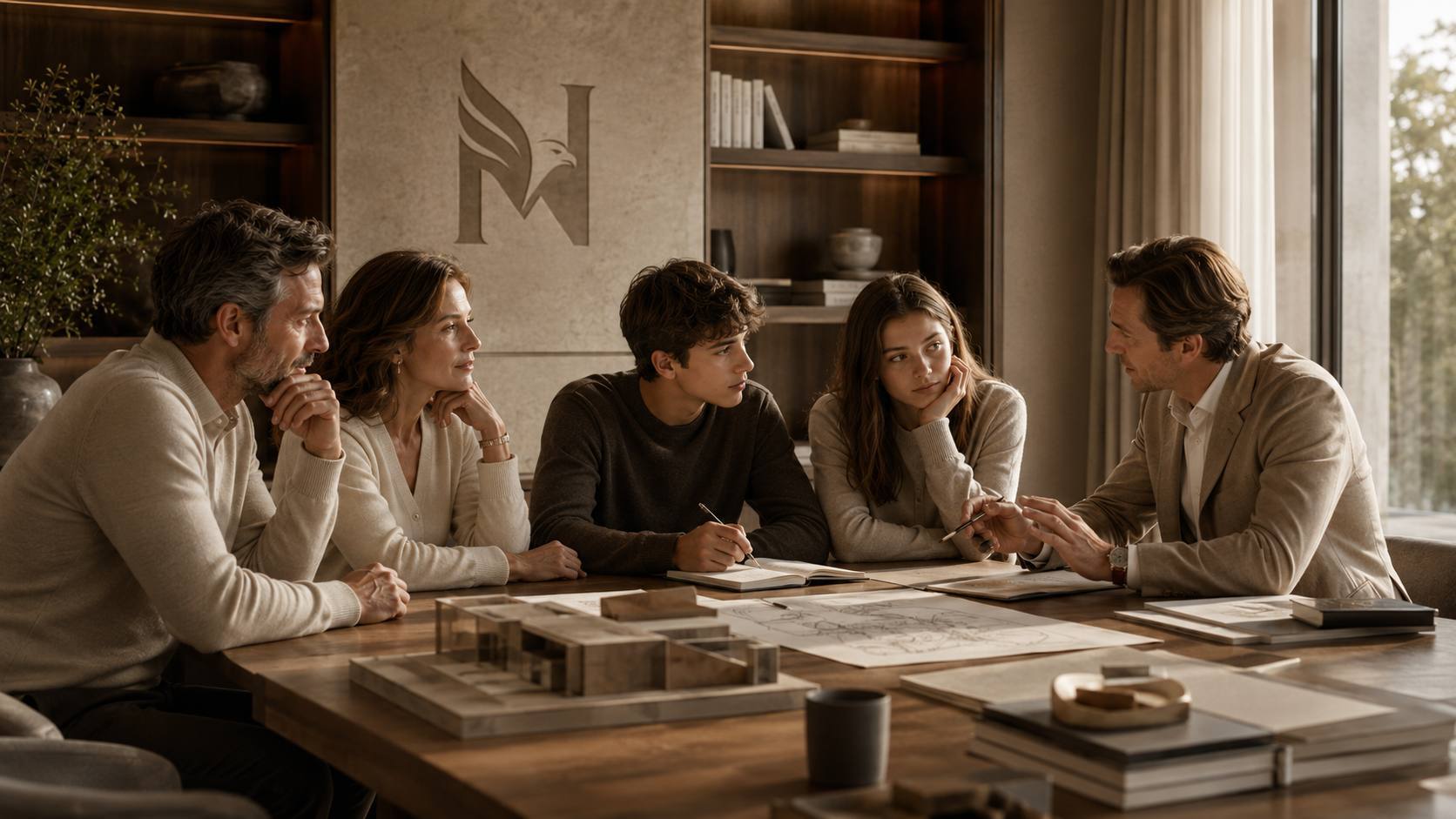
Gathering scene.
The folder with documents lay on the table so neatly, as if order had already been achieved. The ownership structure is ready. The shares have been distributed. The transfer procedure is described. The lawyers did their job.
The father spoke calmly: “Now the main thing is that there are no disputes later.”
This is the right concern. Arguments can truly destroy a family faster than a bad market.
The son nodded. The mother hardly interfered. Everything looked outwardly correct: the papers were ready, the people were assembled, the topic was unpleasant, but necessary.
Then the question came:
Which heir has already made a decision on which not his personal money, but the stability of the entire family depended?
And the room became quiet.
The heirs were not weak. The parents were not indifferent.
It’s just that this family thought well about what the children would get, and hardly talked about what they would have to become.
The family closed the issue of inheritance. The question of succession remained open.
Inheritance answers the question: to whom will the asset pass?
Continuity answers another question: who will be able to hold the decisions, responsibility and meaning for which this asset was created.
These are different questions. If a family confuses the two, it can legally transfer the capital and simultaneously lose the ability to manage it.
The documents may be correct. Assets can be transferred without dispute. Shares can be arranged neatly. But the person who has received the right to own may not understand why to own, what the cost of risk is, and to whom this capital creates a liability.
A family may transfer ownership to a person who has never trained to be an owner.
And then the inheritance will take place. Continuity - no.
The heir receives the right.
The successor accepts the role.
The heir appears in the documents. The successor appears in the family culture.
The heir may own. The successor must be able to stop, ask for advice before it is too late, and not confuse independence with the desire to prove adulthood.
That is why not every heir becomes a successor.
And not every successor is necessarily the primary legal heir.
In a strong family, these figures can coincide. But this coincidence does not happen by itself. It cannot be ensured only by the will of the founder, the quality of documents or the hope that the children will figure it out later.
While the founder is active, the problem is often invisible.
He makes decisions. Knows people. Remembers the history of agreements. Understands which risks are acceptable and which cannot be touched. Knows where the documents are, who to call, where to pause, and where to act quickly.
It holds more than just capital. It keeps context.
From the outside it looks like sustainability. Inside, it may be one person who has too much on their plate.
As long as he is around, the family feels like everything is working. But sometimes it is not order that works, but people.
And it's not just control that makes it difficult for a founder to hand over a role. Sometimes he is afraid to see that his life’s work may no longer continue in his own way. He may dream of a sequel and fear the moment when the sequel will no longer be a copy.
This conversation becomes even more difficult if the second partner in the family has not been included in the logic of capital for years. Then continuity becomes a later test of the entire family architecture: who knew, who was nearby, who was silent.
This is a human gap. And that is why it cannot be closed only with documents.
When the founder gets tired, gets sick, retires, or simply ceases to be the sole bearer of decisions, it becomes clear: there is a hereditary structure, but succession has not been built.
In the Architecture of Family Capital, this distinction can be summarized into three gears: right, map, and judgment.
The right is formalized by documents. Who owns it? Who gets it? Who signs? Who inherits? In what order? Under what conditions?
The map is collected within the family.
Why are assets collected this way? What money should not be touched in a panic. Who to call on the first day of a crisis. Where is the line between business and family?
Judgment takes years to develop.
This is the ability to distinguish risk from adventure, adviser from seller, courage from the desire to prove adulthood.
The family can transfer the right and not transfer the card.
Then the heir knows what belongs to him, but does not know what to do with it on Monday morning.
The family can pass the card and not pass the judgment.
Then the heir knows where everything is, but does not know how to choose what to touch when everyone around him gives different advice.
The judgment does not appear on the day the documents are signed.
At first, the person is simply allowed into the conversation. Not so that he could decide for adults, but so that he could hear how adults think.
It is especially important that he sees how the family refuses a golden opportunity and explains to itself why it is impossible to put at stake what should protect life.
Then he is given a small area of responsibility, where the mistake will not yet destroy the family, but will already cost something real. Not a toy choice, where the consequences will be canceled by the parents. And not enormous power, where the first mistake can become a family trauma.
Then they discuss with him not only the result, but also the motive: why you wanted to do this, what you were afraid of, where you couldn’t stand the pause.
And only then access expands.
This is how it is not the recipient who grows, but an adult participant in the family system.
If this ladder is not there, the family often makes two opposite mistakes.
For too long he does not allow the heir to the reality of capital, and then expects adult behavior from him.
Or gives too much access before the person has gained the internal ability to retain it.
Both mistakes are costly.
Most often, it is not children who interfere with continuity.
It is disturbed by the architecture of adults.
The founder is not ready to relinquish control. Parents are afraid to talk to their children about money. Children are given access to benefits, but not given access to solutions. Mistakes are prohibited, but responsibility is not taught.
So the child or adult heir receives a strange signal: capital exists, but my adult place is not in it.
You can be close, but you cannot be included.
This is how not a successor is formed, but an observer under capital.
Or, conversely, a person who one day receives too much power before he has grown to its weight.
In the first situation, the heir remains infantile next to what he does not understand.
In the second, he receives weight before he has learned to bear it.
The documents answer the question of law. This level cannot be discounted. A family without legal clarity can turn inheritance into conflict, uncertainty, and a fight over interpretation. Specific probate, tax and estate decisions should be reviewed by subject matter experts in the relevant jurisdictions.
But the documents do not answer another question: what a person will do with the acquired right.
Will he understand capital as a tool for family life or as personal spoils? Will he be able to listen to specialists, and not just use their services? Will he be able to develop what he received without betraying the meaning for which it was created?
This is not formalized by a notary.
This is fostered through participation, conversations, rules, limited areas of responsibility, family decisions, mistakes with consequences, and the right to ask adult questions.
Inheritance conveys rights. Continuity conveys controllability.
The right can be issued.
Controllability here is not about control for the sake of control. This is the simple ability of the family to act: who decides, by what rules, with what card and for what.
The architecture of family capital does not start with the question “how to formalize an inheritance.”
It starts earlier.
What children already see every day without any lectures.
What rules are clear before the conflict, and not after it.
Who needs not access, but a route.
Because the child inherits not only what is written in the document. He inherits the decision-making culture he saw at home.
If mistakes in the family are only punished, but not sorted out, the child inherits a fear of making decisions.
If capital exists without meaning, it inherits an asset without internal direction.
Succession begins long before the transfer of assets.
It begins at the moment when the family stops seeing children only as future recipients and begins to see them as future participants in the system.
Check not the documents, but the continuity.
Who in the family can explain why the capital was created?
Who knows where key documents, assets, liabilities and contacts are?
Which children or adult heirs have already participated in real family decisions?
Who in the family has the right to say: this decision cannot be made alone?
If the answers are not obvious, the problem is not with the heir.
The problem is that the family has not yet created an adult place for him next to the capital.
Family businesses rarely break down on inheritance day.
It starts to break down earlier.
When children don’t know why they need this capital. When the founder is not ready to let go of the role. When no one said out loud what would happen if he disappeared.
Money falls last.
Before them, the system of meanings, roles and decisions breaks down.
At this moment, the family stops asking only: who will get it?
And for the first time it asks: who can avoid betraying what it was created for?
We use cookies
Cookie settings
Essential cookies are always enabled because they are required for the website to work correctly.
Analytical cookies from Yandex Metrica can be enabled or disabled.
Analytical cookies from Yandex Metrica can be enabled or disabled.
