
Мы используем cookie
Настройки cookie
Обязательные cookie всегда включены, так как они нужны для корректной работы сайта.
Аналитические cookie Яндекс.Метрики и статистики платформы Tilda можно включить или отключить. Они помогают нам видеть статистику посещений и улучшать сайт.
Аналитические cookie Яндекс.Метрики и статистики платформы Tilda можно включить или отключить. Они помогают нам видеть статистику посещений и улучшать сайт.
Capital Transfer: Heirs Change More Than Advisers
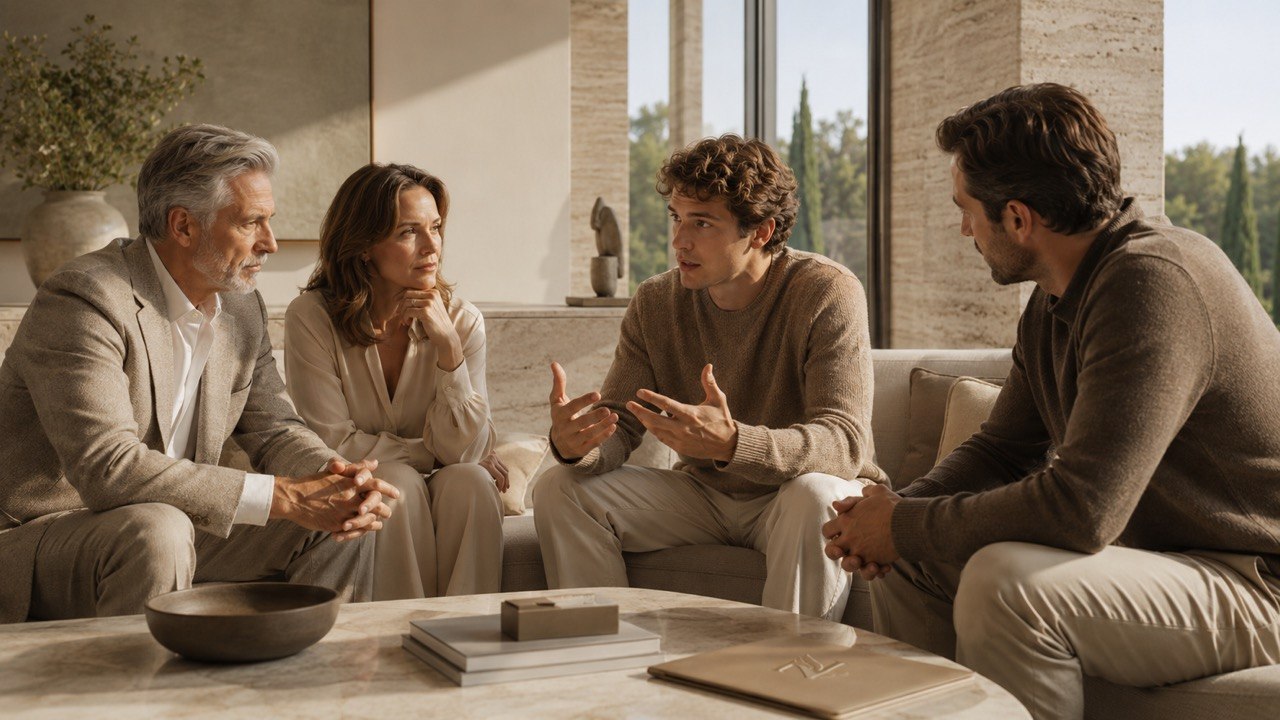
A grown heir sits in a meeting with the family adviser.
The adviser speaks with confidence. He has known the family for a long time, has known the founder for more than 20 years, remembers the old decisions, the structure of the assets, the habits of the main person, the logic of the portfolio and the people at the banks.
The heir listens almost in silence.
Then he says: “You have known my father for a long time. That is understandable. But are you ready to work with me just as attentively? Because I will not simply repeat what he did. I am different. And my capital will be different.”
The room goes quiet. The adviser looks at the founder. The founder is silent.
The question was not about the portfolio. The question was whether the family system is ready to see the new owner of the capital.
The world is entering a period of great transfer of wealth between generations. The UBS Global Family Office Report 2025 links the future of the family office with wealth transfer, succession planning, governance and professionalization. The UBS Billionaire Ambitions Report 2025 states that in 2025 91 people became billionaires through inheritance and received a combined $297.8 billion, and that at least $5.9 trillion will be inherited by the children of billionaires over the next 15 years.
But this transfer no longer resembles a simple change of name in the documents. Heirs change more than advisers. They change the purpose of capital.
But this transfer no longer resembles a simple change of name in the documents. Heirs change more than advisers. They change the purpose of capital.
The older generation often created capital out of scarcity, risk, control, labor and personal responsibility. The next generation may enter capital from a different environment: global education, digital tools, a different sensitivity to meaning, influence, freedom, publicity, personal boundaries, sustainability, social responsibility and psychological safety.
If the family does not recognize this difference, the heir may accept the assets but reject the former purpose of the capital.
This is where the main question for a wealthy family appears: what does a family council look like in which the founder and the heir have not a decorative but a real right to a voice? Not in a presentation. In life.
If there is no answer, the transfer will remain formal. The heir will receive the assets but will not receive a place in the system of decisions.
On the surface this looks like a change of bank, manager, lawyer or consultant. At depth it is a change of trust.
The heir asks: do they understand me here? Do I have a right to a voice? Can I understand why this structure was created? Can I respect the past and still not live someone else's life? Can I carry capital without becoming a copy of the founder?
The heir asks: do they understand me here? Do I have a right to a voice? Can I understand why this structure was created? Can I respect the past and still not live someone else's life? Can I carry capital without becoming a copy of the founder?
There is one more shift: long life.
Founders remain active for longer. The older generation keeps its influence for longer and needs medical, financial and everyday support for longer. The middle generation spends longer caught between children, parents, business and its own burnout. Heirs wait longer for a real role in the capital, but form their own attitude to money, work, freedom and meaning much earlier.
The transfer of capital becomes not an event but a many-year test of the family architecture.
Advisers also fall into this break. Those who for many years worked only with the founder may fail to hold on to the next generation. Not because they were bad. But because their language, their style of decisions and their attitude to risk were tuned to one person, not to the family system.
The heir may not argue. He may simply leave: change the adviser, sell an asset, withdraw from participation, move to another country, create his own trajectory. Or remain in the family outwardly, but inwardly stop believing in its architecture.
The heir may not argue. He may simply leave: change the adviser, sell an asset, withdraw from participation, move to another country, create his own trajectory. Or remain in the family outwardly, but inwardly stop believing in its architecture.
A family often thinks it is transferring assets. And at that moment the heirs are deciding whether they will continue the former purpose of the capital.
Preparing the next generation is needed here not as a financial literacy course. It is a contour of growing up alongside capital: the history of the family, the language of decisions, the right to ask a question, the experience of responsibility, the ability to disagree without destroying, an understanding of structures, working with mistakes, participation in family conversations appropriate to age and maturity.
What needs to be passed to the heir is not only knowledge about instruments. What needs to be passed is judgment.
Continuity does not mean that the new generation is obliged to repeat the old one. It means that the new generation understands what has been passed to it and is able to continue without mechanical copying and without destructive rebellion.
The final question: will the next generation inherit from you only the assets, or also the right to consciously continue or change the purpose of the capital without destroying the capital itself?
We use cookies
Cookie settings
Essential cookies are always enabled because they are required for the website to work correctly.
Analytical cookies from Yandex Metrica can be enabled or disabled.
Analytical cookies from Yandex Metrica can be enabled or disabled.
