
Мы используем cookie
Настройки cookie
Обязательные cookie всегда включены, так как они нужны для корректной работы сайта.
Аналитические cookie Яндекс.Метрики и статистики платформы Tilda можно включить или отключить. Они помогают нам видеть статистику посещений и улучшать сайт.
Аналитические cookie Яндекс.Метрики и статистики платформы Tilda можно включить или отключить. Они помогают нам видеть статистику посещений и улучшать сайт.
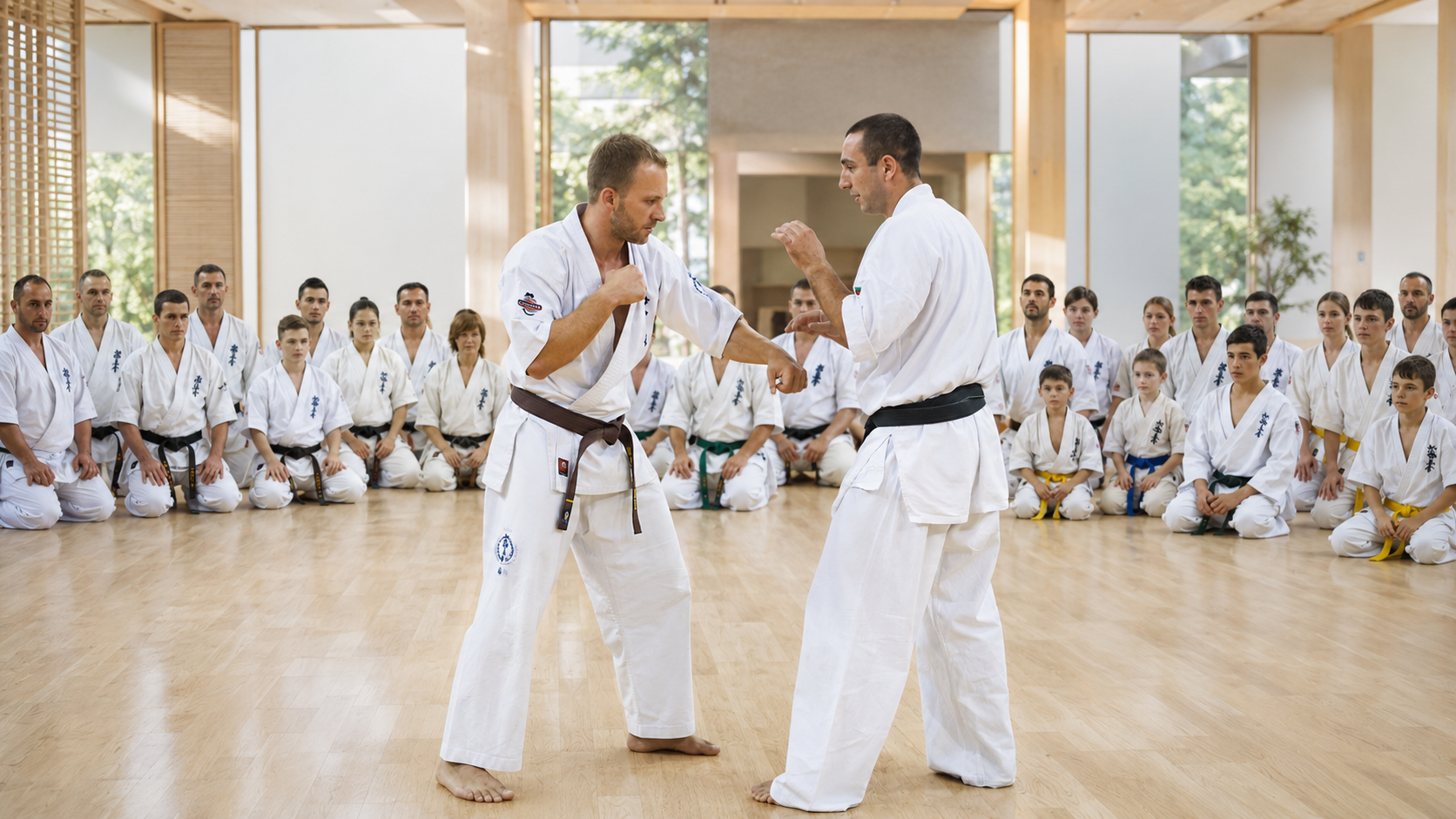
What Karate Taught Me About Capital
Judo has been part of my life since I was eight, and Kyokushin karate since I was thirteen.
With them came a saying that a child can repeat almost as a game, but an adult one day understands as a principle:
Fall seven times, stand up eight.
In judo, you first learn to fall. Before learning to win, learn to meet the ground properly: without breaking, panicking or resisting what has already happened. Falling becomes part of movement rather than its end.
Kyokushin later added another dimension: directness, form, striking, breathing, pressure and the willingness to stand when the body asks to retreat.
Karate does not teach attractive aggression. Real karate teaches you to withstand yourself under pressure: beyond your mood, your image or your words about discipline.
Very early, in primary school, an inner formula emerged in me, almost a personal vow:
“I will go further and higher. That, it seems, is how Heaven made me. You up there, can you hear me? Even alone in the field, I will be a warrior.”
This was not a pose. It was more a way of answering the world when uncertainty appears ahead and almost nobody understands why you would go there.
“I will go further and higher. That, it seems, is how Heaven made me. You up there, can you hear me? Even alone in the field, I will be a warrior.”
This was not a pose. It was more a way of answering the world when uncertainty appears ahead and almost nobody understands why you would go there.
In my fifth year at university, a lecturer from business visited our cohort and told us that Americans were opening an experimental laboratory for industrial automation and robotics. Volunteers were being recruited for an experimental course.
There were about seventy of us. At first, nobody stood up.
The information was unfamiliar, the risk unclear, the prospects uncertain. It was the kind of moment when staying still is easiest: wait, watch, ask what others think.
I stood up first.
Four others followed. One said something like: “We didn’t understand any of it, but if you’ve decided, we’re with you. You can explain it later.”
It was a small scene containing much of the future. I did not yet know that I would build systems that had not existed before, or enter places without a ready-made route. An Architect’s responsibility begins before everything is clear, when someone must be first to rise into uncertainty and withstand the solitude of that first step.
In the army I understood something else: when a system humiliates people, it cannot be called order. Later I saw a similar pattern in families where the outside world called it “responsibility”, while inside one person simply deprived the others of a voice.
One voice suppresses another. One person decides, while the rest live with the consequences. Someone stays silent because it is safer. Someone calls fear respect. Someone calls control care. Each time I recognise the same structure: external order without dignity inside.
Karate taught me that form without spirit is dead. Family capital works in the same way.
A family can have documents, assets, accounts, a portfolio, insurance and an attractive plan. But without an inner code, disciplined decisions, respect for another person’s voice, willingness to face the truth and the capacity to withstand crisis, these remain a shell.
Capital, like form in karate, is sustained by repetition, discipline, rhythm and the ability to remain faithful to an inner code under pressure, rather than by intention alone.
Money tests the family’s form. Crisis tests its stance. Succession tests whether the family had something to teach the next generation.
In karate, performing a kata beautifully once does not make its form yours. It must be repeated, refined and lived through the body. A family likewise cannot discuss rules once, draw up a plan once and prepare documents once, then consider its architecture complete.
In karate, performing a kata beautifully once does not make its form yours. It must be repeated, refined and lived through the body. A family likewise cannot discuss rules once, draw up a plan once and prepare documents once, then consider its architecture complete.
Later, karate ceased to be only my personal practice. It became a way of passing something on.
This led to the children’s project “Satori Kids”. I trained children at weekends, and once a month their parents joined them. They stood in line with the children and experienced the rituals, traditions, culture and challenges. They did not watch from the sidelines or merely “know” what their child was doing. They experienced the child’s path through their own bodies.
I did this because my parents did not attend my tournaments when I was a child. Other athletes had families, friends, support and familiar eyes in the stands. I was alone.
I did not yet describe it as a methodology. But somewhere inside, a decision had already formed: it would be different for my children.
Falling seven times and standing up eight is about more than sport. It is about capital that must not collapse at life’s first blow, and a family that can recover its form after conflict, loss, exhaustion, fear, error, relocation, a market crisis or the illness of its key person.
It is also about an Architect who has no right to build for others what he has never learned to withstand through his own body.
It is also about an Architect who has no right to build for others what he has never learned to withstand through his own body.
We use cookies
Cookie settings
Essential cookies are always enabled because they are required for the website to work correctly.
Analytical cookies from Yandex Metrica can be enabled or disabled.
Analytical cookies from Yandex Metrica can be enabled or disabled.
