
Мы используем cookie
Настройки cookie
Обязательные cookie всегда включены, так как они нужны для корректной работы сайта.
Аналитические cookie Яндекс.Метрики и статистики платформы Tilda можно включить или отключить. Они помогают нам видеть статистику посещений и улучшать сайт.
Аналитические cookie Яндекс.Метрики и статистики платформы Tilda можно включить или отключить. Они помогают нам видеть статистику посещений и улучшать сайт.
We use cookies
Cookie settings
Essential cookies are always enabled because they are required for the website to work correctly.
Analytical cookies from Yandex Metrica can be enabled or disabled.
Analytical cookies from Yandex Metrica can be enabled or disabled.
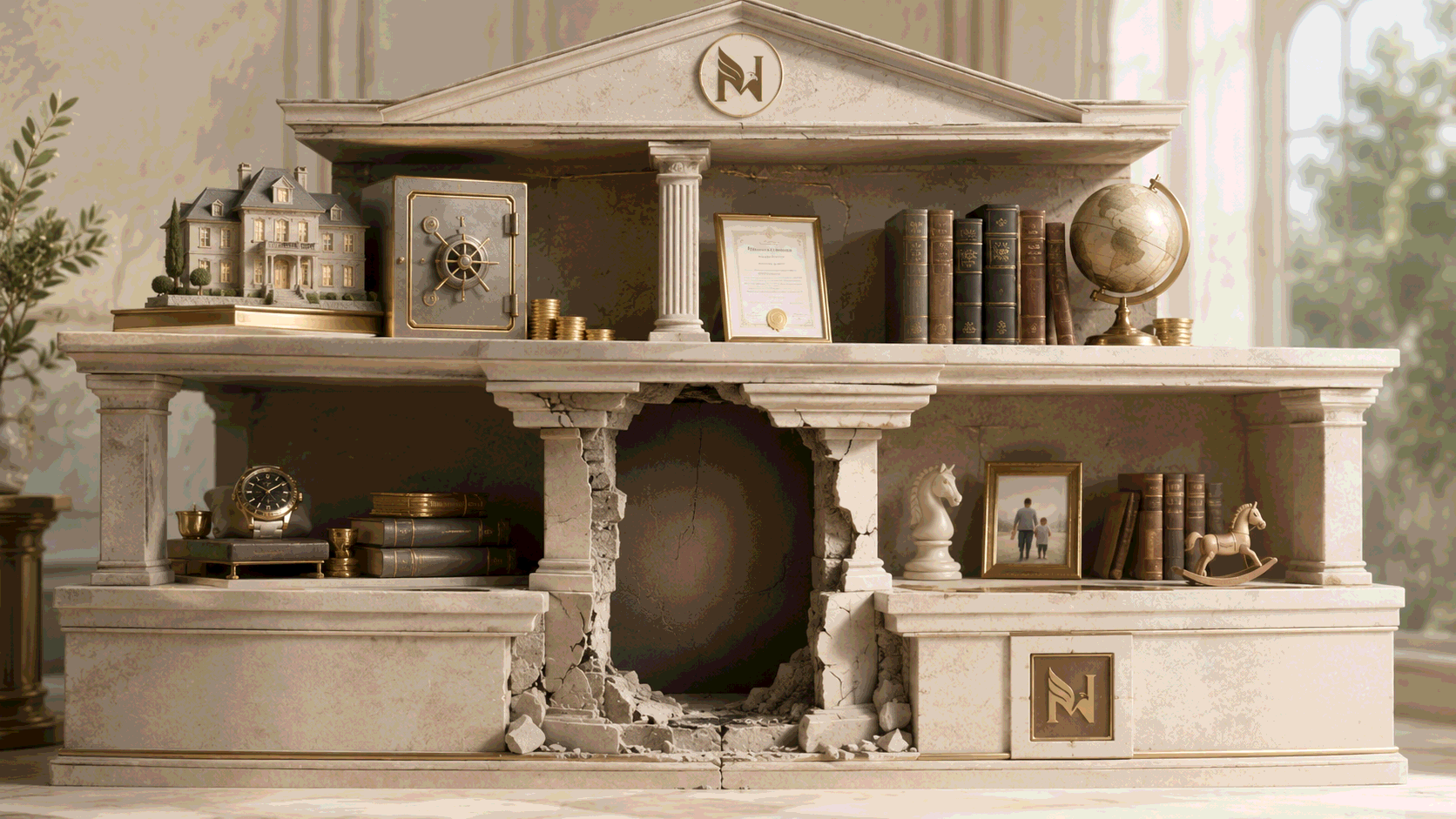
When there is money but no capital
There may be money. There may be no capital.
At first glance this sounds strange. If you have assets, income, real estate, a business, an investment account - isn't that capital?
In the architecture of family capital - no. Money is a form. Capital is ability.
The family's ability to live, choose, protect, create, negotiate, pass things on, withstand crises and continue. If this ability is weakened, the money remains. But family capital as a system is already fragile.
The most common sign of such fragility looks like strength: everything rests on one person.
He knows accounts, makes investment decisions, stores access, remembers where documents are, knows lawyers, bankers, ownership structure and the history of all agreements. In the family’s language, this is called “he knows how it all works.” In architectural language this is called concentration of systemic risk.
If this person becomes unavailable, the family will lose more than just income or speed of decisions. It will lose its bearings. Only he had the map. And he did not have time to pass it on to others.
There is a less obvious sign: money is beginning to replace conversation.
We didn’t discuss the conflict - we bought a gift. If we didn’t talk to the child, we paid for a new lesson. They didn’t make a decision about the future - they went on a good vacation. They didn’t name fear - they strengthened the portfolio. Money can temporarily alleviate tension. But if they constantly replace conversation, the family begins to become poor in things that do not count as money.
We didn’t discuss the conflict - we bought a gift. If we didn’t talk to the child, we paid for a new lesson. They didn’t make a decision about the future - they went on a good vacation. They didn’t name fear - they strengthened the portfolio. Money can temporarily alleviate tension. But if they constantly replace conversation, the family begins to become poor in things that do not count as money.
Children are a separate area of concern.
They may have a good school, travel, opportunities, access to the world. But they lack a language for work. They have no experience of boundaries. They have not learned to make mistakes: small, independent, with understandable consequences. There is no understanding why “no” is sometimes more protective than another “yes”.
Then the children do not inherit the capital. They inherit access to the form without internal support. And the day they need judgment and not just money, they will have nothing to turn to within themselves.
Wealth creates the noise of prosperity.
High income drowns out bad decisions. Assets mask the owner's fatigue. Status makes silence seem respectable. In a wealthy family, money can compensate for many gaps for a long time: lack of time, lack of a second voice, lack of a culture of responsibility in children, lack of rules that can withstand stress.
But such gaps cannot be filled with money indefinitely. At some point, they cease to be a household inconvenience and become a family structure.
Big capital rarely changes the character of the system. More often than not, it enhances what is already there at the base.
If there is trust in the family, money expands opportunities. If there is fear, money increases control. If there is silence, money makes it expensive. If there is dignity, money becomes an instrument of service. If there is chaos, money allows chaos to not look like chaos longer.
Therefore, the question is not how much money the family has. The question is which system they are strengthening.
Capital is where money is embedded in a mature system of life, decisions and succession. Not only where there is ownership, but where there is management. Not only where there is income, but where there is the ability to refuse income if it requires too high a price. Not only where there are children, but where children gradually learn responsibility because they see it around every day.
Family capital is the ability of a family to continue without loss of people, meaning and the right to a future.
Family capital is the ability of a family to continue without loss of people, meaning and the right to a future.
One question: What will disappear in your family if you remove assets but leave people at the same table?
If the answer comes quickly, there is capital. If a question causes a pause, it’s worth looking there.
If the answer comes quickly, there is capital. If a question causes a pause, it’s worth looking there.
